

Sébastien El Idrissi is not a designer who announces himself. From his calm, light-filled studio in Zurich's Seefeld neighborhood, he makes things that are quietly becoming hard to ignore. His work tends to share a common preoccupation: utility, structure, and an attention to what everyday objects actually do to a space.

He trained as a structural metalworker before studying product design at ECAL, and spent time as an in-house designer at offices in Copenhagen and Zurich. Since 2019 he has worked independently, with clients across Europe and Japan.
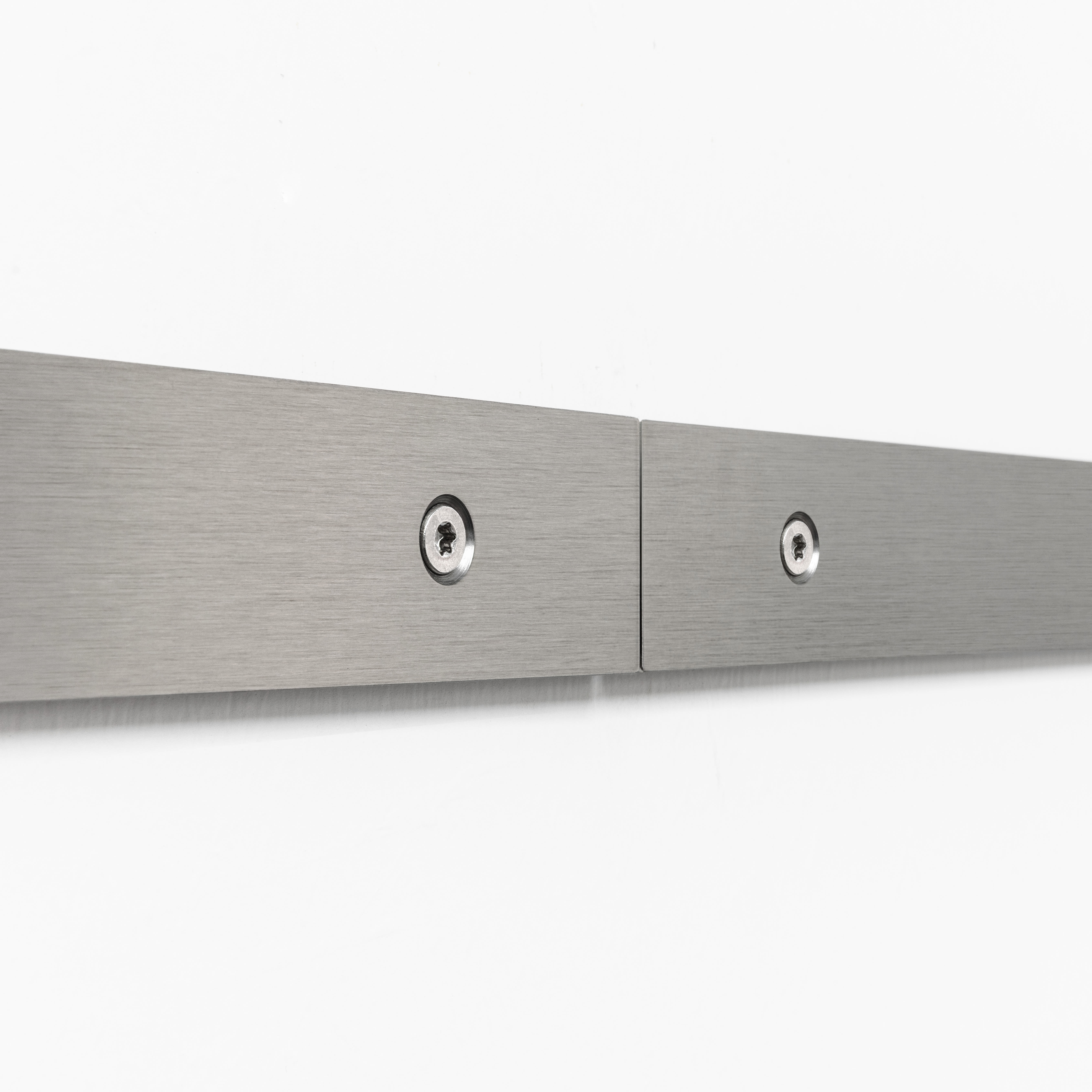
For Studiotools he designed the Wall Rail — a wall-mounted stainless steel track that lets Studioboards, Layers, screens, shelves, and accessories be attached, rearranged, and combined at will. He also designed a coat hook to go with it: a small object with a specific intention — to make the whole system feel more like somewhere you'd want to be.
How did this project come about?
It grew out of something else, as these things often do. Studiotools had brought me in for a different project. But once we started looking seriously at the existing Wall Rail, it became clear pretty quickly that there was more to do. The central question became: how do you make a wall a genuinely active part of a room?
What does that mean in practice?
A table works because it gives people a reason to gather — you can put things on it, sit at it, move around it. It creates a center. We wanted the Wall Rail to do something similar, but vertically. To give walls a role. You can hang things, shift them, add to them, take them away. Whiteboards, pinboards, screens, jackets — whatever the room needs.
What drew you in?
Two things: the reduction to what's essential, and what that reduction does to the atmosphere of a room. The earlier Wall Rail used a complex profile to solve two problems at once — hiding the screws, protecting the wall. But solving both that way made the profile too wide and, honestly, not very attractive. The new design addresses both problems differently and arrives at a single clean line. The material changed too: painted aluminum became raw stainless steel with a brushed finish. The result has a presence in the room that feels right — precise, but not cold. And it invites you to use it.
Let's talk about the coat hook. Where did that come from?
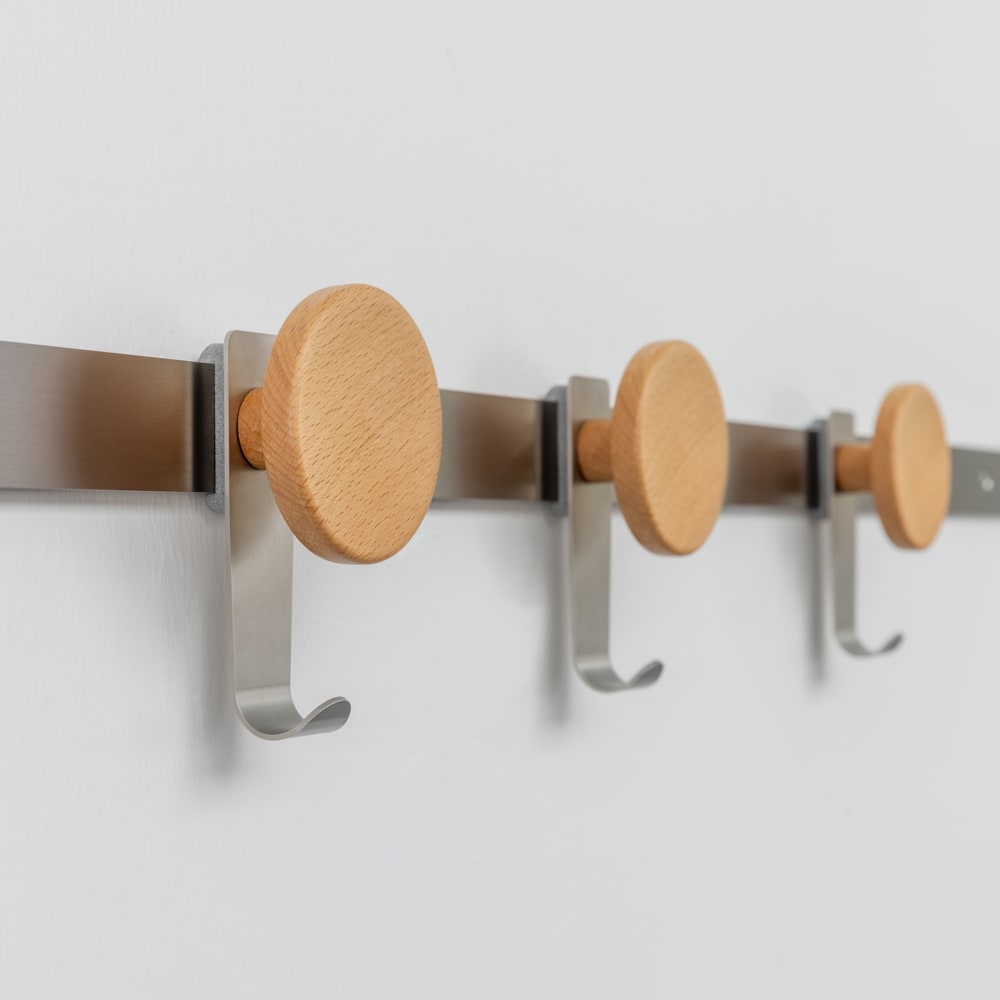
That brief came from Studiotools. Meeting rooms almost never have somewhere to put a jacket, a bag, a cycling helmet. It sounds like a small thing, but it matters — a room that doesn't account for bodies doesn't quite feel finished. The hook modules — a wooden disc, a small metal hook — fix that, whether you mount one or a dozen.
Tell me about the design decisions.
The material contrast was the starting point. The rail is stainless steel: cool, precise, industrial. The hook needed to feel different. The beech disc is round, warm, tactile — the kind of thing your hand finds without looking. Together they make an object that earns its place on the wall rather than just occupying it.
What does the Wall Rail actually do to a room when you use it properly — across multiple walls?
The Studioboards have always been about lightness, and the flexibility that comes with it. The Wall Rail extends that — everything is in reach, nothing is in the way, and nothing is permanent. You can set the room up for ten people in the morning and four in the afternoon. It takes two or three moves. That kind of adaptability changes how a room feels before anyone's even decided how to use it.
What are you hoping for as the collaboration continues?
To see the system grow. The first pieces are in place — boards, layers, screens, the coat hook — and now comes the part where real use teaches you things you couldn't have anticipated. That's always where the interesting problems emerge. I think there's more this system can solve. We'll find out.