Walk into a meeting room after a workshop. The wall is covered in torn-off sheets of paper. Marker ink, half-legible. Arrows. A line struck through. A circle around something that mattered.
Now ask yourself: why are they on the wall, and not in a cloud somewhere?
The teams using them aren't anti-technology. They have screens. They have whiteboards. They have Miro accounts. The sheets are on the wall because something about that act — tear, lift, stick, keep — does work that the screen does not.
We pay attention to that.
Whiteboards and flipcharts look similar from across the room. They are not similar. They are two different tools for two different acts of thinking.
A whiteboard is for thinking out loud. The eraser is the permission to be wrong. You write, you cross out, you start over. The medium itself says: nothing here is final. Try again. The whiteboard, used well, is generous and forgiving and amnesiac. By Friday afternoon it will not remember what you decided on Tuesday morning.
A flipchart does something else. You write, you turn the page, you keep it. The tear-off is an act of commitment — a small physical decision that this matters enough to detach from the rest. The sheet exists now. You can hand it to someone. You can hang it on a wall. You can take it to another room.
Whiteboards iterate. Flipcharts capture. Whiteboards develop ideas. Flipcharts record them. Whiteboards forget. Flipcharts remember.
These aren't preferences. They are different cognitive operations — and good teams know how to switch between them.
There is a moment in any serious workshop where the work tips from exploration to commitment. The room knows it before the agenda does. The conversation slows down. Someone says: let's write that down. Not on the whiteboard — on a flipchart. Because once it is on the sheet, and the sheet comes off, it is no longer hypothetical.
That small act — pulling the sheet free — does something to a group. It marks the transition from "what if" to "this is what we decided."
And then there is the second behavior, often missed. Workshops produce many parallel ideas. Ten whiteboards side by side? Fine — that is what we build. A hundred is a different question. You can hold a hundred torn-off sheets on a wall — each one its own thought, all of them visible at once. The room becomes the record. People walk along it, point at things, group them, move them around. That, too, is thinking. It happens in space, between bodies and objects. It cannot happen on a screen.
This is why we built a flipchart in 2026. Not because we missed it. Because we noticed, again and again, that there were rooms full of expensive technology where the most important moment of the day still involved a piece of paper and a marker.
We wanted to build the version of that object that we would actually want in our own studio.
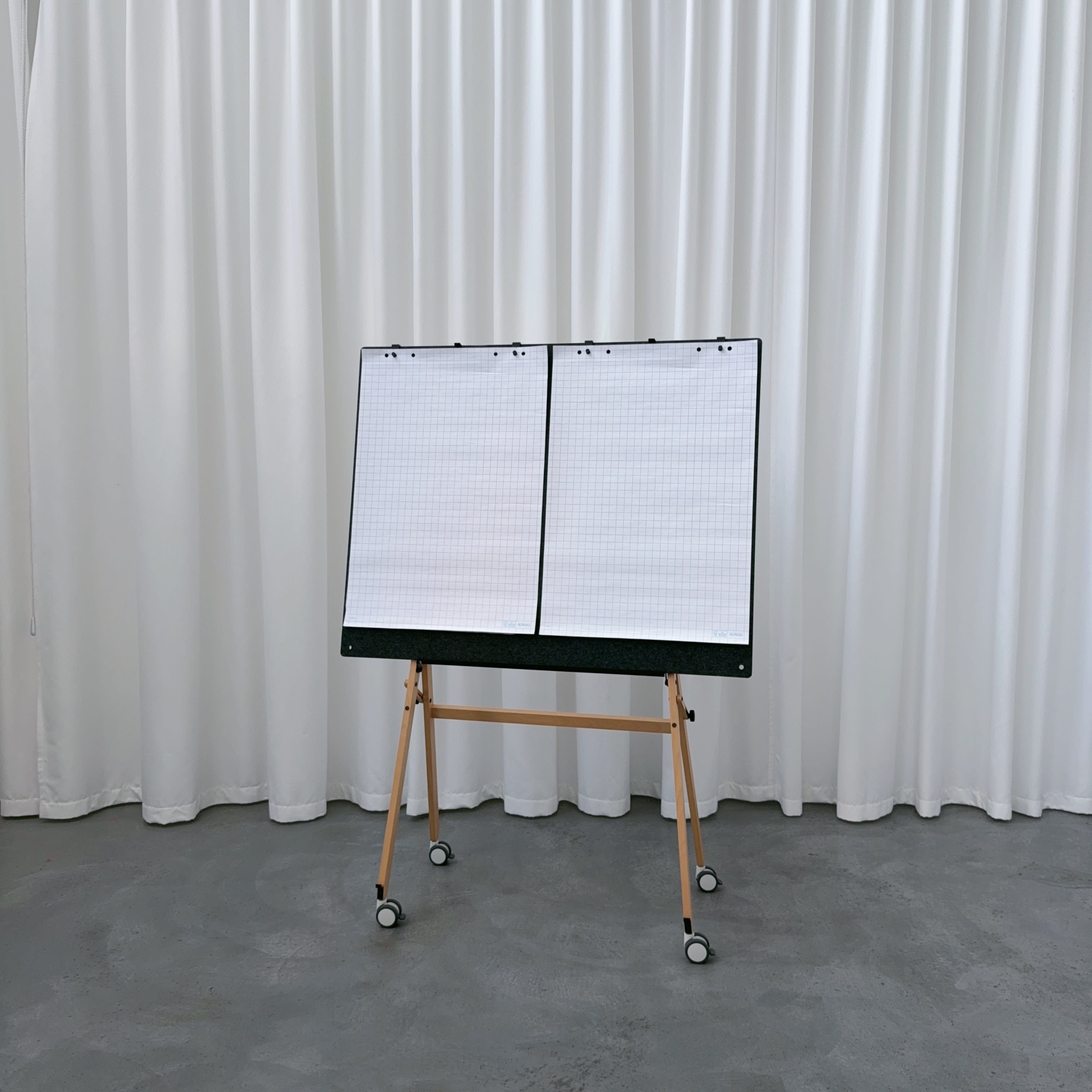
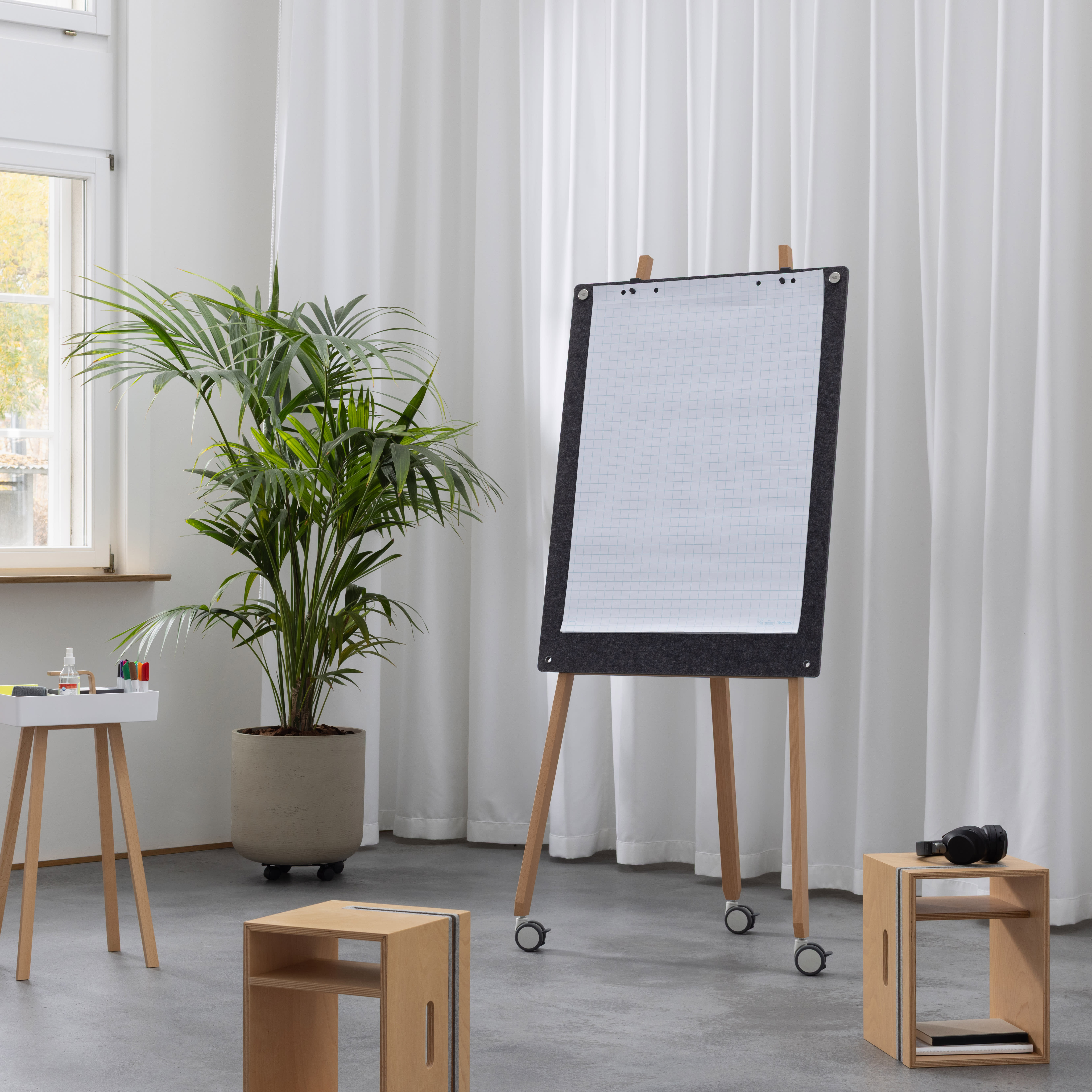
It is made of steamed beech, which is why it belongs to the same family as everything else we build. It stands on three legs, because workshop floors are rarely flat, and a flipchart that wobbles is a flipchart you stop trusting. It folds, because tools should disappear when no one is using them. And when it folds, it leans against the wall in a slim profile that does not announce itself — no rear leg sticking out, no claim on the room.
It accepts flipchart blocks. It accepts our Layers. It accepts Write & Pin panels. We tried not to be clever about which paper you put on it. That is your decision, not ours.
The wall after a workshop, with its torn-off sheets, is a kind of monument. To the conversation, to the conclusion, to the small physical acts that took the team from one to the other.
The flipchart is the tool that produces the monument.
That is why we built one.
P.S.: One? Hardly. Fitted with Layer 1.5, our Easel becomes a double flipchart